
Free and Open Source ERP - ERP next

  Introduction What is an ERP system? And why should businesses use it? Today, small and medium-sized businesses (SMEs) also face some of the problems that large enterprises do. One of them being planning and managing their resources. SMEs face similar complexities but have limited resources to deal with them. Small businesses (like their bigger counterparts) have to: Do accounts to track their sales/purchases. Do their taxes. Pay their employees. Manage deliveries within promised timelines. Deliver quality goods and services. Communicate with customers, answer their queries. Large enterprises invest millions of dollars in highly sophisticated systems like SAP. SAP and similar systems are able to handle requirements from these large enterprises to bring their  multi-country ,  multi-company ,  multi-currency , global businesses into a single platform. This has helped them achieve consolidation of data/records in the fundamental processes such as accounting, taxation,...

SAP FI Define Posting Keys


Posting Keys in SAP FI are used to determine Account types (A, D, K, M, and S) and also the type of posting. It is 2-digit numerical key.

Different Account Types in SAP FI −

  • A = Assets
  • D = Customers
  • K = Vendors
  • M = Materials
  • S = General Ledger Account

Asset Posting Keys

Posting KeyDescriptionDebit/Credit
70Debit AssetDebit
75Credit AssetCredit

Material Posting Keys

Posting KeyDescriptionDebit/Credit
89Stock Inward MovementMaterial Debit
99Stock outward MovementMaterial Credit

There are various Account type posting keys available in SAP FI.

How to create a SAP FI Posting Key?

Go to SPRO → SAP Reference IMG → Financial Accounting → Financial Accounting Global Setting → Document → Line Item → Controls → Define Posting Keys → Execute.
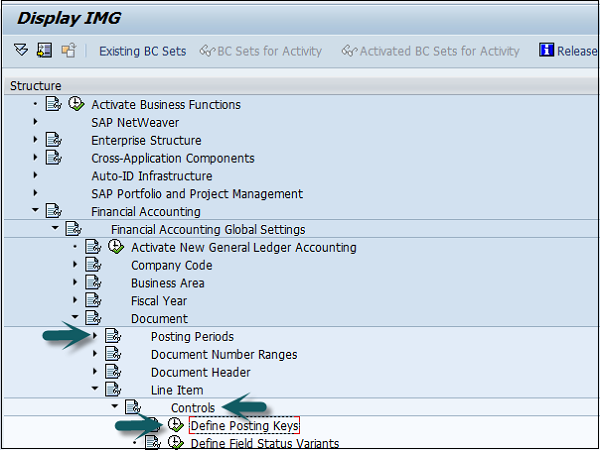
Define Posting Key

Click the Create icon.

Create Posting Key

Enter the 2-digit numeric code (Example ‘02’) and the name of the posting key and press the Enter key.
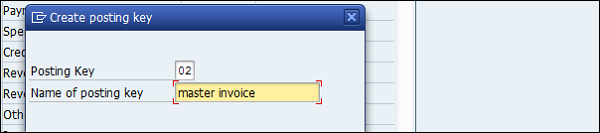
2-digit Numeric Code

Now you need to provide the following details −

  • Debit/Credit Indicator − Select Debit or Credit.

  • Account Type − Select the Appropriate account type.

  • Other Attributes − Select other appropriate attributes.

  • Reversal Posting Key − Update the reversal posting key.
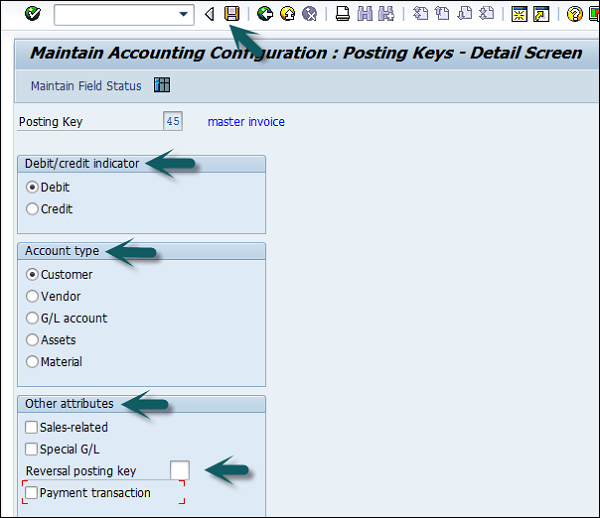
Maintain Acc Config Posting Key

The next step is to click the Save icon to successfully configure the posting key.

Comments

Popular posts from this blog

SAP FI Journal Entry Posting

The use of Journal Entry (JE) posting in SAP FI is to take a batch, validate it for consistency, and create FI documents and post those entries in various line item accounts needed for subsequent business processing. JE Posting is a process that, with a few exceptions, runs "behind the scenes" and is the heart of Journal Entry. It receives journal entry data (representing financial transactions) from the PRA modules (Valuation, Revenue Distribution, etc.), and summarizes them in batches and posts them to the PRA JE line item tables and to SAP FI. Journal Entry Posting is the link between the journal entries coming from PRA applications and the FI documents and JE line item table items that are created. How to post a journal Entry in SAP FI? Use  T-code  FB50 → Provide the Company code. Enter the document date as shown below − The next step is to provide the following details − G/L Account  − Enter the account to be credited. Short Text  − Description of amount. Amoun...

SAP FI - Functional Area

Function Areas in finance accounting are used to define the expenses in a company according to individual function units. The most common Functional Areas are − Manufacturing Sales and Distribution Production Administration How to Define a Functional area in SAP FI? You can define a Functional Area using the  T-code  FM_FUNCTION (Earlier it was OKBD, but this is obsolete). It will open a new window. Click on Create Functional Area as shown below and a new window will open. Enter the following details − Name of Functional Area. Description Validity to and from date Expiration date and Authorization. Once all the details are provided, click the Save button at the top. Once you click Save, you will see a message at the bottom that a new functional area has been created. Functional Areas are used to create Profit and Loss statements using the cost of sales accounting and they are also used to analyze the cost of sales accounting. For this, you need to activate the cost of sales ac...

SAP FI - Company Basics

A company is defined as the smallest unit for which financial statements can be created in accordance with commercial legal regulations. In SAP FI, a company can comprise of multiple codes, however it acts as a single unit for which financial statements are available. All the company codes must use the same chart of accounts list and fiscal year, however each code can have a different local currency. A chart of accounts list consists of all the chart of accounts that can be used and each code must have one chart of account. A fiscal year normally consists of twelve months’ time period where company creates the financial statements. SAP FI – Create Company Login to SAP FICO Use  T-code  SPRO → click on SAP Reference IMG → New window will open. Expand SAP Customizing implementation guide → Enterprise Structure → Definition → Finance Accounting → Define Company → click on Execute (see the pointer in the screenshot). A new window will open → click on New Entries → New Entries: Det...
